1 The Undercharging Trap
It usually starts with a reasonable fear: "If I raise my prices, I'll lose clients." So spa owners set rates low to stay competitive, then stay low because they're afraid to rock the boat. Over time, low prices attract clients who shop on price — and those clients are the hardest to keep, the first to complain, and the least loyal.
There's also the impostor syndrome factor. Plenty of talented therapists quietly believe they haven't "earned" higher rates yet — that they need more certifications, more years, more five-star reviews before they deserve to charge $130 for a massage. They do not. Clients pay for results, for trust, and for how they feel walking out your door.
The math is brutal: if you charge $70 per session, see six clients a day, and work five days a week, you gross $2,100/week before supplies, rent, software, and taxes. Raise that to $110 and the same schedule grosses $3,300/week — a 57% revenue increase without a single extra booking. Undercharging isn't cautious. It's expensive.
The hidden cost of cheap pricing: Low-price clients book once to "try it," cancel last-minute because they don't feel invested, and leave reviews complaining that $70 "wasn't worth it." Premium-price clients book recurring appointments, tip well, refer their friends, and buy gift cards for the holidays.
2 Research Your Local Market First
Before you set or change a single price, spend 30 minutes doing proper competitive research. Open Google and search "massage near me" — then click through to the websites of the five to eight businesses that appear on the first page and in the Google Maps pack.
For each competitor, note:
- Their 60-minute Swedish price
- Their 90-minute deep tissue price
- Whether they offer packages or memberships
- Their Google rating and review count
- The overall feel of their brand (budget, mid-market, or premium)
You'll almost always find a clear price range — say, $65 on the low end and $140 on the high end for a 60-minute session. Your goal is not to undercut the low end. Your goal is to understand where the market sits and position yourself at or above the midpoint. If competitors with worse reviews and a dated website are charging $110, you have room to charge $125 and win on presentation alone.
3 Build a Three-Tier Pricing Framework
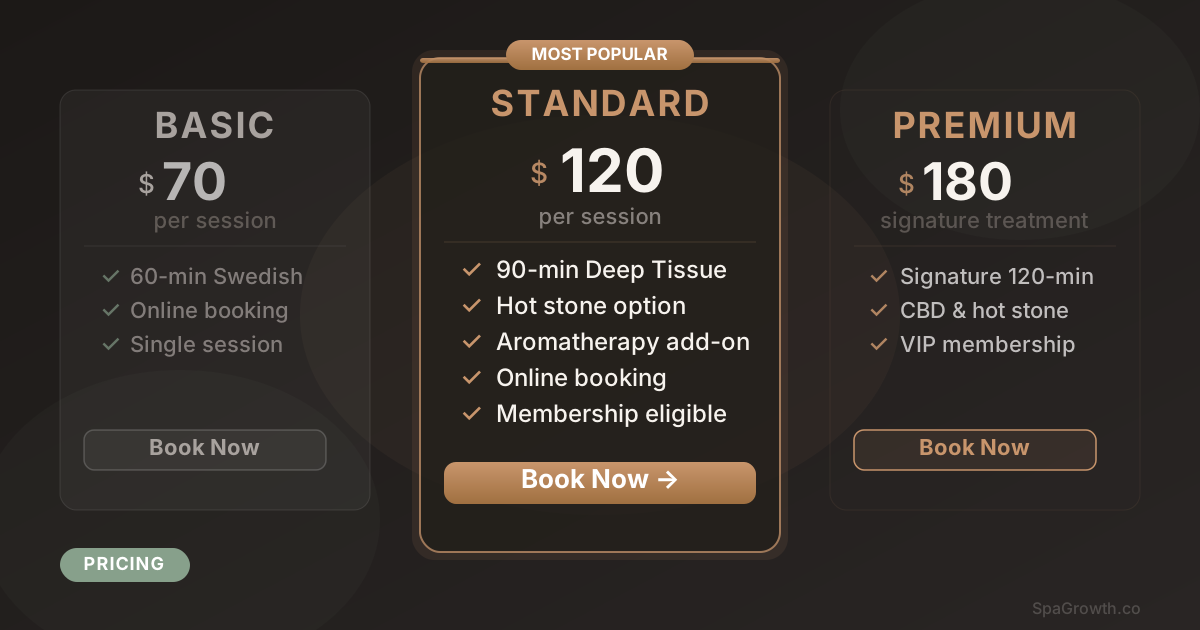
A menu with three clear tiers does two things: it makes decision-making easy for clients, and it anchors their perception of value. When someone sees three options, the middle one almost always feels like the smart choice — which is exactly where you want your most-booked service to live.
Entry Tier — The Accessible Starting Point
This is your 60-minute Swedish massage: the lowest barrier to try your spa. Depending on your market, $75–$95 is a strong price for a mid-market spa in a mid-size city. Premium urban markets can push this to $110–$120 without hesitation. Set it low enough to get new clients in the door — not so low that it signals bargain-basement quality.
Mid Tier — Your Revenue Engine
The 90-minute deep tissue, hot stone, or prenatal massage. This should be your most-promoted service. Price it at $110–$155 depending on your market. At this tier, the session length justifies a meaningfully higher price, and the specialisation gives you permission to charge for expertise. This is where most of your upsell revenue will come from too — aromatherapy, CBD oil, and hot stone add-ons all attach naturally here.
Premium Tier — Your Signature Experience
A 120-minute signature treatment, a couples massage, or a curated package. Price this at $160–$220+. It won't be your most-booked service, but it dramatically raises the perceived value of everything on your menu. When a client sees your signature treatment at $195, your $125 deep tissue suddenly looks like great value.
Pricing tip: End prices in 5s or 0s, not 9s. "$125" reads as confident and professional. "$124.99" reads as a grocery store discount. Spa clients are buying a premium experience — the price should feel that way.
4 Why You Should Not Be the Cheapest Option
Being the cheapest massage in town is a race to the bottom — and even if you win, you lose. Here's what the data consistently shows about low-price clients: they are more likely to no-show, less likely to rebook, less likely to refer friends, and more likely to complain or leave a critical review when expectations aren't met.
Price is a signal. When someone searches for a massage and finds your $65 option next to a $125 option, they make assumptions about quality. They might book the cheap one once — but they'll tell their friends about the good one. Premium clients are not looking for the lowest price. They're looking for someone they can trust with their body, their time, and their stress. They want to feel confident they've chosen the right place.
Charging appropriately also protects your energy and your business. A spa that's fully booked at $75 is actually in worse shape than one that's 70% booked at $125 — less revenue, more physical output, higher burnout risk, and a clientele trained to expect cheap.
Want more ideas for filling your calendar with the right clients? See our guide on how to get more massage clients — specifically the section on Google reviews and local SEO, which is where premium clients are searching.
5 How to Raise Prices Without Losing Clients
The good news: most clients will not leave when you raise prices, especially if you handle it thoughtfully. The ones who do leave are almost always the price-sensitive clients you'd rather replace anyway.
Here's the approach that works:
- Give 30 days' notice. Send an email or text to your client list: "Starting [date], our session prices will be updated to reflect the quality of care we provide." Keep it brief and confident — don't over-explain or apologise.
- Grandfather loyal clients for 60 days. Offer your regulars — anyone who's booked more than twice in the past six months — their current rate for one final 60-day window. This rewards loyalty, softens the transition, and gives them a reason to book soon.
- Frame the increase as a reflection of value. "We've invested in continued training, upgraded our products, and refined our treatments" is a completely honest and compelling reason. You don't need a dramatic justification. Confidence in your pricing is itself a message to clients.
- Update everything at once. Website, booking software, social media, printed menus. Inconsistency creates confusion and questions.
Reality check: In fifteen years of spa industry data, a well-communicated 10–20% price increase results in an average client attrition rate of 5–10%. If you raise prices and lose 5 clients, but your revenue per session goes up 15%, you're almost certainly ahead — and the clients you kept are your best ones.
6 Packages and Memberships — The Recurring Revenue Play
The single most powerful financial move a massage spa can make is introducing a membership programme. Here's why the math is so compelling:
A simple membership at $99/month that includes one 60-minute Swedish massage (with your standard rate at $90) gives the member $9 in value plus the convenience of never having to book and pay each time. It also gives you guaranteed, predictable monthly revenue. At 40 members, that's $3,960/month hitting your bank account on the first of every month — before you book a single additional session.
At 80 members, you're at $7,920/month recurring. That's the difference between a spa that's always chasing bookings and one that has a stable financial floor to build from.
Membership clients also book more consistently, try more services, buy more add-ons, and refer more friends than one-off clients. They feel invested in your spa because they literally are.
Package pricing as an alternative entry point
If a full membership programme feels like too much to launch right now, start with session packages. A 5-session package at a 10% discount creates the same commitment effect without the recurring billing infrastructure. A client who's bought five sessions is not leaving after two.
Want a membership programme that practically sells itself?
A professional website with online booking, automated follow-ups, and a clear pricing page makes memberships an easy yes. We build exactly that for massage spas — in under two weeks.
Book a Free Strategy Call →7 Add-On Upsells That Don't Feel Salesy
Add-ons are one of the highest-margin revenue streams in a spa, and yet most therapists feel awkward presenting them. The trick is to offer them as part of intake — not as a sales pitch during the session.
Build add-ons into your booking flow and your intake form: "Would you like to enhance today's session?" When it's framed as a customisation option rather than an upsell, acceptance rates climb significantly.
Typical add-on pricing that works:
- Aromatherapy — $15. Essential oils are low-cost, high-perceived-value, and clients love personalising their session.
- Hot stone enhancement — $25. Adds meaningful time and tangible value. Easy yes for deep tissue clients.
- CBD oil upgrade — $20. Growing demand, especially for chronic pain and stress clients. Position as a targeted treatment option, not a wellness trend.
- Scalp massage extension — $15 for 10 minutes. Near-zero overhead, very high perceived value, and clients almost always rebook requesting it.
Offer two add-ons during booking — one mid-priced, one lower-priced — and let clients choose. Presenting a menu of six options creates decision fatigue. Two is the sweet spot.
Pricing audit checklist:
Research: Have you checked 5–8 local competitor prices in the past 6 months?
Tiers: Do you have a clear entry, mid, and premium service on your menu?
Positioning: Are you priced at or above the local midpoint?
Recurring revenue: Do you offer a membership or multi-session package?
Add-ons: Are add-ons presented at booking, not during the session?
Last increase: Have you raised prices in the past 12 months?
8 The Confidence Factor
Here's the thing that no pricing guide fully captures: clients don't just pay for the massage. They pay for the confidence that they're in good hands. A therapist who apologises for their rates, or who drops their price the moment someone hesitates, is sending a signal — and it's not a reassuring one.
When you charge what your work is worth, without flinching, you communicate something important: I know what I do, I'm good at it, and I stand behind it. That confidence is part of the experience clients are buying. It's why a $150 massage at a calm, well-presented spa feels worth more than a $90 massage at a place that's clearly scraping to survive.
Pricing is not just a financial decision. It's a positioning statement. It tells potential clients who you are, who you serve, and what kind of experience they can expect before they ever walk through your door.
Set your prices with the confidence of someone who has earned them — because you have. Then build the website and online presence that backs that positioning up. If your pricing says premium but your website looks like 2015, there's a gap you'll want to close. That's where we come in.
Ready to attract the clients who value what you offer? Read our guide on getting more massage clients through Google, or book a free strategy call and we'll walk through your specific market together.