Why Reviews Are Your Most Valuable Marketing Asset
When a new client searches "massage spa near me," they don't know you yet. They have no reason to trust you over the four other spas on that same results page. So they do exactly what you'd do: they look at the stars.
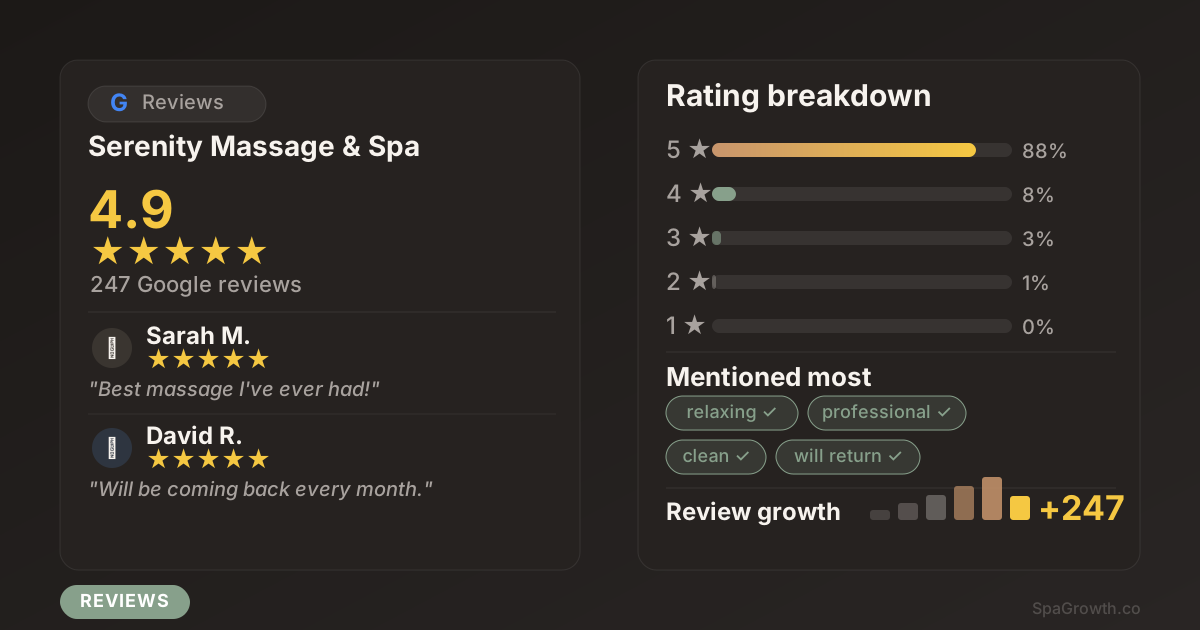
88% of consumers trust online reviews as much as a personal recommendation from a friend. Think about that. A review from a stranger carries nearly the same weight as a word from someone's best friend. And in the wellness industry — where people are literally letting someone touch their body — that trust factor is even higher than average.
Beyond trust, Google reviews are the single most important local ranking signal Google uses to decide who shows up in the Maps 3-pack. More reviews, higher average rating, and recent review activity all push you higher. A spa with 180 reviews and a 4.8 average will almost always outrank a spa with 20 reviews and a 5.0 — because Google sees the volume as a signal of real-world relevance and activity.
The math is simple: more reviews means a higher ranking, which means more new clients discover you, which means more reviews. It's a flywheel — and once it gets spinning, it's hard for competitors to catch up. The hard part is getting it started.
The gap is real: The average small spa has fewer than 30 Google reviews. The top-ranked spa in most markets has 150–300+. That gap is beatable with the right system — and most of your competitors aren't running one at all.
The 5-Step Review Collection System
Most spa owners ask for reviews in the worst possible way: awkwardly, at the wrong time, with no follow-through. This system fixes all three problems.
1 Ask at the right moment
The absolute best time to ask for a review is immediately after the session ends, while the client is still in that warm, relaxed post-massage glow. Their stress is gone, their body feels incredible, and they're genuinely grateful. That's the moment the request feels natural — not like a sales pitch.
Train your therapists to say something simple and genuine as they hand the client their water or escort them back to the front desk:
"I'm so glad you're feeling better. If you have a moment, it would really mean a lot if you left us a Google review — it helps us so much. I'll send you a quick link."
That's it. No pressure, no script that sounds rehearsed. Just a warm, human ask at the right time.
2 Make it completely frictionless
The number one reason clients don't leave reviews isn't that they don't want to — it's that they forget, or they don't want to dig through Google to find your page. Eliminate that friction entirely.
Get your Google review link: Go to your Google Business Profile, click "Share review form," and copy the direct link. Shorten it with Bitly or use a custom short URL like spagrowth.co/review that redirects there.
Then create two assets:
- A QR code card — Print a small, beautiful card (match your brand) with a QR code that opens your review page directly. Leave one on the checkout counter, one in the treatment room, one in the waiting area.
- Your direct link — Use this in text messages and email follow-ups (step 3).
Quick win — the QR code card: You can generate a free QR code at qr.io in about 5 minutes. Print 20 cards at Canva + a local print shop for under $10. Place one at checkout with a simple line: "Loved your visit? Scan to share it." This one change alone can double your monthly review count.
3 Send an automated follow-up text 24 hours later
Life gets busy. That client who genuinely loved their session forgot to scan the QR code by the time they got home. A single, friendly text the next day brings them right back to that good feeling — and to your review page.
Here's the exact SMS template that works:
Hi [First Name]! It was great seeing you at [Spa Name] yesterday. Hope you're still feeling wonderful ✨ If you have 60 seconds, a Google review means the world to us — here's the link: [your review link]. Thank you so much! — [Therapist Name]
Keep it short, personal, and warm. Don't include the link without context — that feels spammy. The personal touch ("hope you're still feeling wonderful") bridges back to the session and reminds them why they'd want to leave a kind word.
Tools like Podium, NiceJob, or even a simple SMS platform can automate this so it fires 24 hours after every appointment without anyone on your team having to remember.
Want a done-for-you review system?
We build review automation directly into our spa websites — including automated SMS follow-ups and QR code assets. Book a free strategy call to see how it works.
Book a Free Strategy Call →4 Respond to every single review
Responding to reviews is not optional. Google's algorithm treats owner responses as a signal of an active, engaged business. And prospective clients read your responses just as carefully as they read the reviews themselves — they're forming a picture of what it's like to be your customer.
For positive reviews, keep responses warm and specific:
- Use the reviewer's name if they included it
- Reference something specific they mentioned
- Invite them back with a forward-looking line
"Thank you so much, Sarah! We're thrilled the deep tissue session hit the spot — we'll let Maria know you said so. We'd love to see you back next month. See you soon!"
Aim to respond within 24–48 hours. Set a weekly calendar reminder if you need to. It takes 10 minutes a week and the compounding effect on your reputation is enormous.
5 Handle bad reviews with grace
A single 1-star review is not a disaster. How you respond to it is what determines whether it hurts you. Potential clients who see a thoughtful, professional response to a negative review often trust you more — because it shows you care and you take ownership.
Here's the step-by-step process for any negative review:
- Wait 24 hours before responding. Never reply when you're frustrated or defensive.
- Acknowledge their experience — even if you disagree with how they described it. Don't argue. Don't make excuses.
- Apologize that they left disappointed — not necessarily that you did something wrong, but that their experience fell short of what you want for every guest.
- Offer to make it right — invite them to contact you directly (include your email or phone) to discuss a resolution.
- Keep it brief — two to four sentences maximum. Long defensive responses look worse than short gracious ones.
Example response to a bad review:
"Hi [Name], thank you for taking the time to share your experience. We're sorry your visit didn't meet the standard we hold ourselves to — that's truly not the experience we want for any guest. We'd love the chance to make it right. Please reach out to us directly at hello@yourspa.com and we'll take good care of you."
This response is disarming, professional, and invites resolution off the public platform. Most reasonable people reading it will see you in a positive light.
What You Must Never Do
Google's review policies exist to protect consumers — and they enforce them. Violating them risks getting your entire review profile removed or your Business Profile suspended.
- Never buy reviews. Purchased reviews are detectable by Google's algorithms, violate their terms of service, and can result in permanent suspension of your Business Profile. It's simply not worth it.
- Never practice review gating. This means asking only happy clients for reviews while discouraging unhappy ones. Example of what not to do: "Did you enjoy your visit today? If yes, we'd love a Google review. If not, please let us know privately." Google explicitly prohibits this, and it's why some third-party tools have gotten in trouble.
- Never write reviews yourself — or ask staff, friends, or family to write fake reviews. Google checks for patterns and geographic anomalies. You're not fooling anyone, and the risk is enormous.
- Never offer incentives in exchange for reviews. "Leave us a review and get 10% off your next visit" is against Google's policies. You can mention reviews in general marketing, but you cannot directly link a reward to the act of writing one.
The good news: you don't need any of these shortcuts. A real system applied consistently will generate far more reviews than any fake approach — and they'll stick around.
The Compounding Effect: Why 50 Reviews Becomes 500
Here's the part most spa owners don't think about. Reviews create a self-reinforcing cycle that accelerates over time.
When you hit 50 reviews with a strong average, you start ranking higher in local search. That higher ranking brings in more new clients. More new clients means more sessions. More sessions means more review requests. More reviews pushes you higher still. The clients who find you through Google Maps are often the most motivated to leave a review, because that's the platform where they discovered you.
A spa with 200 reviews doesn't just have 200 pieces of social proof — it has a self-sustaining review engine. New clients arrive already primed to trust you because of what the previous 200 said. They have a great session. The system sends a follow-up text. They leave review #201.
The hardest part of this flywheel is the first 30 reviews. After that, momentum does most of the work. This is why starting now — even imperfectly — matters far more than waiting until you have the "perfect" system.
If you want to go deeper on the broader strategy for attracting new clients, our guide on how to get more massage clients covers the full funnel beyond reviews.
Your 30-Day Review Challenge
Stop treating reviews as something that just happens. Treat them as a metric you actively manage. Here's a concrete 30-day plan:
- Day 1: Get your Google review direct link. Shorten it. Add it to your phone's contacts so it's always one tap away.
- Day 2: Design and print your QR code card. Place one at checkout and one in each treatment room.
- Day 3: Brief your team. Role-play the ask. The verbal request after a session takes 15 seconds — but only if it's practiced.
- Day 5: Set up a simple follow-up process. Even a manual text to each client 24 hours after their appointment is infinitely better than nothing. Automate it when you're ready.
- Week 2: Respond to every review you currently have — old ones included. This signals to Google that your profile is active.
- Week 3: Check your review count. Set a goal: 10 new reviews this month. Track it like any other business metric.
- Week 4: Review what's working. Which therapists generate the most reviews? What follow-up timing gets the best response? Refine from there.
- Day 30: Count your new reviews. If you followed the system, you'll have 8–15 new reviews. That's meaningful movement — and month 2 will be easier.
The spas that dominate local search aren't doing anything magical. They have a system, they work it consistently, and they let the compounding do its job. You now have the system. The rest is execution.
Want to skip the setup? Our Review Automation add-on handles this entire system for you — automated follow-up texts, review monitoring, and monthly reporting — for $29/month. It's the highest-ROI add-on we offer. Most spas recoup the cost with a single new client their reviews brought in.