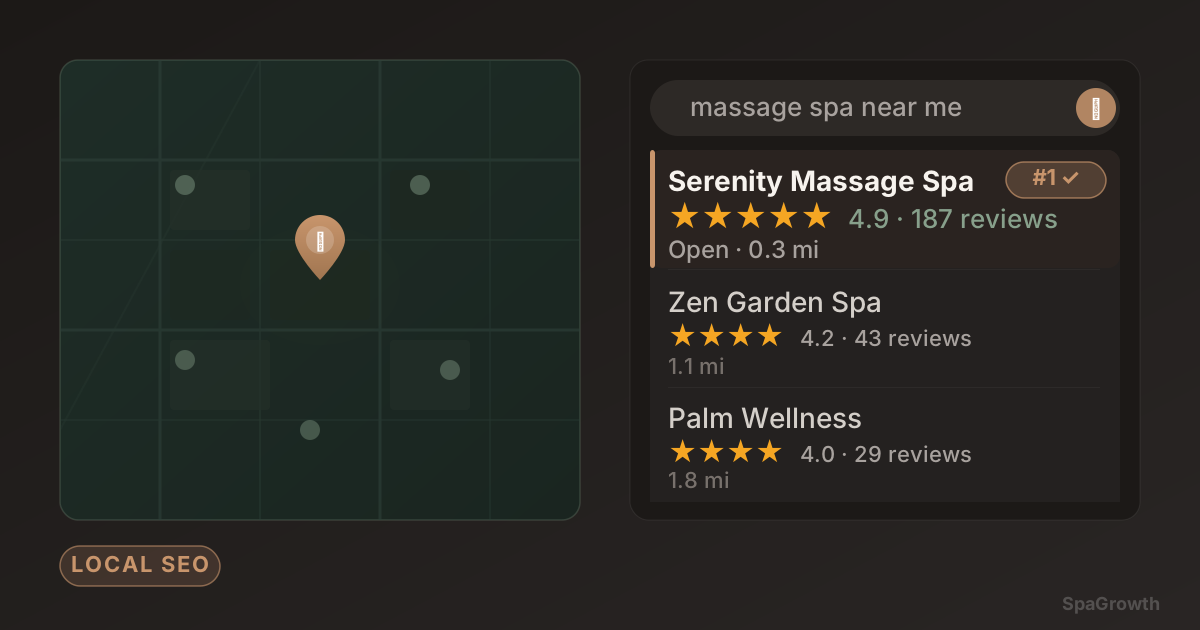
The Google Maps 3-pack — the three businesses that appear with a map at the top of local search results — captures roughly 44% of all clicks on the page. Businesses in organic results below it get far less. Being in the 3-pack for "massage spa [your city]" is the equivalent of having a prime storefront on the busiest street in town, except it's free and it works 24 hours a day.
The businesses that occupy those three spots aren't there by accident. They've done specific things that Google rewards. Here's what those things are.
How Google decides who appears in the 3-pack
Google uses three factors to rank local businesses:
- Relevance — how well your business matches what the person searched
- Distance — how close you are to the searcher
- Prominence — how well-known and trusted your business is (reviews, links, mentions)
You can't control your distance from searchers. But you can significantly influence relevance and prominence — and that's where most spas have room to improve.
Step 1: Claim and fully complete your Google Business Profile
If you haven't claimed your Google Business Profile, do that first at business.google.com. If it's already claimed, make sure every field is filled in — incomplete profiles rank lower.
The fields that matter most:
- Business name — use your real name, no keyword stuffing ("Miami Massage Spa — Best Relaxation" gets flagged)
- Category — primary should be "Massage therapist" or "Day spa." Add secondary categories for each service type
- Address — must be exact and match your website and all other listings
- Phone number — local number preferred (not a national 800 number)
- Website — link to your homepage or a dedicated landing page
- Hours — keep these accurate and update for holidays
- Description — 750 characters, use your main keywords naturally ("massage spa in [city]", service names)
- Services — list every massage type and add-on service with prices
- Photos — minimum 10 photos. Interior, exterior, team, treatment rooms
Profile completeness matters: Google explicitly states that businesses with complete profiles are "twice as likely to be considered reputable" and get 7x more clicks than incomplete ones.
Step 2: Build reviews — systematically, not sporadically
Reviews are the single biggest factor separating businesses in the 3-pack from those just outside it. Not just the star rating — the volume and recency of reviews matter just as much.
A spa with 180 reviews averaging 4.6 stars will almost always outrank a spa with 40 reviews averaging 4.9 stars. Consistency beats perfection.
How to get reviews without being annoying about it
- Timing is everything — ask right after the session, when the client is relaxed and satisfied. That's when they're most likely to say yes.
- Remove friction — don't ask them to "search Google and find your profile." Give them a direct link. Create a short URL (bit.ly works) that goes straight to your review form.
- Automate the follow-up — a text 2–4 hours after their appointment: "Thanks for visiting [Spa Name] today! If you enjoyed your session, we'd love a quick Google review: [link]"
- QR code at checkout — a card at the front desk with "Loved your visit? Leave us a review" and a QR code pointing to your review page
Responding to reviews
Respond to every review — five stars and one star. For negative reviews, respond professionally, acknowledge the concern, and offer to make it right offline. Google sees responses as a signal of engagement, and potential clients read them to gauge how you handle problems.
Step 3: NAP consistency — the foundation everything else sits on
NAP stands for Name, Address, Phone number. These three pieces of information need to be identical everywhere your business appears online. Not similar — identical. Same abbreviations, same formatting, same phone number format.
Why it matters: Google cross-references your business information across dozens of sources. Inconsistencies create uncertainty about which listing is authoritative, which suppresses your ranking.
Check and correct your NAP on:
- Your website (homepage footer, contact page)
- Google Business Profile
- Yelp
- Facebook Business Page
- Apple Maps
- Bing Places
- Healthgrades (if you're licensed)
- Any local directories or chamber of commerce listings
Free tool: Moz Local's free check at moz.com/local/search shows you all the places your business is listed and flags inconsistencies. Takes 2 minutes.
Step 4: Optimize your website for local keywords
Your website and your Google Business Profile work together. A fully optimized GBP pointing to a weak website won't rank as well as one pointing to a site that's clearly about massage services in your city.
Key on-site changes:
- Title tag — include your primary service and city: "Massage Spa in Miami, FL | [Spa Name]"
- H1 heading — your city and primary service should appear naturally: "Professional massage therapy in downtown Miami"
- Body copy — mention your city, neighborhood, and nearby landmarks naturally throughout your content
- Footer — include your full address and phone number on every page
- Embedded Google Map — add a Google Maps embed to your contact page (signals to Google that your address is real and accurate)
Step 5: Post to your GBP regularly
Most spa owners claim their Google Business Profile and never touch it again. This is a mistake. Google treats GBP Posts similarly to social media — active profiles get more visibility.
Post once or twice per week. Ideas:
- A seasonal promotion ("Spring stress relief — 20% off deep tissue in April")
- A new service or therapist joining the team
- A recent 5-star review (screenshot and post it)
- A "before/after" tip about muscle tension or self-care
- Photos of your treatment rooms or products
Each post stays visible for 7 days. Consistent posting keeps your profile fresh in Google's eyes.
Step 6: Build local citations
Citations are mentions of your business name, address, and phone number on other websites — even without a link. Getting listed in the right local and industry directories sends trust signals to Google.
Priority citations for massage spas:
- Yelp (high priority — often ranks on page 1 for spa searches)
- Facebook Business Page
- Apple Maps
- Bing Places
- Healthgrades
- Thumbtack
- Your local Chamber of Commerce directory
- AMTA (American Massage Therapy Association) — if you're a member
- Local city/neighborhood business directories
How long does it take?
Honest answer: 2–4 months to see meaningful ranking movement, 4–6 months to consistently appear in the 3-pack for competitive searches. Some spas in less competitive markets see results in 6–8 weeks.
The factors that speed things up:
- Consistent review accumulation (5+ new reviews per month)
- Regular GBP posts
- NAP consistency across all platforms
- A fast, mobile-friendly website with local keywords
Local SEO is not a campaign — it's an ongoing system. The good news is that once you're ranking, maintaining your position is much easier than getting there.
Want us to handle your Google Maps optimization?
SpaGrowth's monthly plans include full Google Maps optimization, review automation, and ongoing SEO — so you don't have to think about it. Book a free call to see what's possible for your spa.
Book a Free Strategy Call →Quick-win checklist
- Google Business Profile claimed and 100% complete
- All GBP fields filled in — categories, services, hours, description, photos
- Review request system in place (text automation or QR code)
- NAP checked for consistency across Google, Yelp, Facebook, Apple Maps
- Website has city + service keywords in title tag and H1
- Google Maps embed on contact page
- GBP post scheduled for this week
- Listed on Yelp, Facebook, Bing Places, Apple Maps
Work through this list over 2–3 weeks and you'll have done more for your local Google ranking than 90% of your competitors.